My name is Abby and I'm a Sherloholic

How good were those three episodes?! Or 'films' is probably the more accurate word for them. As a writer they just make my brain sing with joy (and occassionally grumble and mutter about why I'm not as good as they are). But the How Did Sherlock Fake His Death? debate has unfortunately somewhat overshadowed the rest of the damn fine series.
Because before Sherlock took his climactic swan dive (or did he? etc) series two had been a lovely fairytale about a brilliant, isolated man gradually defrosting and allowing other people into his life, ironically opening up the chinks in his armour that Moriarty ultimately worms into in the process. Steve Thompson - a man who, let's be honest, up until The Reichenbach Fall seemed to be the useless brother-in-law that Moffat felt obliged to give work to - did a great job of giving Sherlock's fake suicide dramatic and lasting impact even after you know he's not dead. It was the moment that the audience finally got to see what John meant to Sherlock. Sherlock planned it all, of course, and prepared his fake death as a last-ditch plan. But he naturally assumed that he'd outwit Moriarty and not have to go through with it - until he learns that John's life is on the line. So he destroys his reputation and says goodbye to the only friend he has just to save his life. Sob.
But there'll be a series three! Hooray!
One final note on Sherlock (which, a couple of weeks on, I still can't get out of my head) - how spectacular was the acting, across the board? Benedict Cumberbatch is everywhere right now, and deservedly so, but that rather detracts from Martin Freeman who, in my mind, stole the show this series. Freeman is just so extraordinary at playing ordinary. What he does is so subtle that a lot of people don't even class it as acting, especially not when he's surrounded by excellent scenery chompers like Andrew Scott (so brilliant as Moriarty this year). But who didn't get a little something in their eye as John struggled to come to terms with his loss?
World's Finest

Wait, I'm who now?
Oh, but wait - Power Girl might be the Karen Starr we know and love, but what's this? Huntress is Helena Wayne again, the original Earth-2 Huntress, daughter of Batman and Catwoman. Helena Bertinelli, who existed as a character for 14 years longer than her Earth-2 counterpart, who appeared in the hugely popular JLU animated series, who is the only version of Huntress that most modern comic readers know, no longer exists in current DC continuity. Well, that's just a slap in the face for a Birds of Prey fan like myself. Helena Bertinelli was one of my favourite characters. I read the first issue of her mini-series in the new 52, and it seems they've kept many of the personality traits of the Huntress I know, but without her history with the Birds she just won't be the same.
It seems that the concept for this series is that Huntress and Power Girl are trying to get back home to Earth-2. Now, I'm already ticked off at the prospect of Earth-2. There are rumours that some of the missing characters - including some of my personal favourites like Donna Troy and Wally West - might pop up on Earth-2. But what's the point when they can't interact with the characters who helped define them? Donna should be having drinks with Dick Grayson, advising him on his love life, not another dimension away. And now they're taking Power Girl and Huntress out of the main DC universe too, provided that they succeed in getting home in. Humph.
Secret Six (last time, I promise)

I finally got round to reading the last Secret Six trade last week (I'm a trades girl), and, well, that was emotional. Anyone who thought the "I thought we might be heroes" ending to the Western one-shot was a killer, wait until you see the final issue.
Over the six years or so that we had the Secret Six (on and off) they grew into the most believable damaged comic book family outside of the Batfamily. Their jaunt to hell in this trade and the surprise (although it shouldn't be) betrayal half way through just serve to solidify their bond. But there just isn't a place in that world of superheroes and supervillains for some messed up folk who just want to get by (and possibly one day kill Batman). Looks like DC editorial couldn't find a place for them either. Although, with any luck, the inevitable increase in interest in Bane after The Dark Knight Rises might see more people buying the Secret Six trades, which, in turn, might persuade DC to look a little bit harder for a place to put everyone's favourite psychopaths. Frankly, I don't want to read a DC universe that doesn't have Catman, Scandal, Ragdoll et al inhabiting a dark little corner of it.

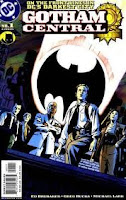 There's not a DC fan alive (over 18) who wouldn't put this at the top of their TV wishlist. It's The Wire of the DCU, and not just because it's a police procedural, but because it is in a class of its own. Great characters, great stories and villains that range from the outlandish Gotham villains like Two Face and Mr Freeze to real-world bad guys like Corrigan.
 Screw a Raven TV show - just do the Teen Titans. You'll end up bringing most of them in as guest stars in Raven anyway, and besides, she works much better as a peripheral character slowly revealed to be far more powerful and screwed-up than anyone realised than as a main character.
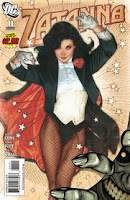 She'd make a great TV lead, juggling a showbiz career and a superhero alter ego, wielding a power that she hasn't quite got her head round yet and featuring a supporting cast of DC's magical characters. I'd put her in her mid-20s and take inspiration from Grant Morrison's Seven Soldiers interpretation, pegging Zee as a bit of a screw-up who drinks too much, has very inapproriate taste in men (Batman and Constantine? Girl likes a bad boy) and has a very sharp, smart tongue, even when she's speaking words the right way round.
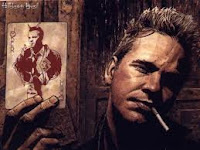 John Constantine, as brought to screen in a British-American co-production would just be heaven. British cast, locations, black humour and grit, with American money. It's about time the Keanu version was wiped from audiences' minds, and this would be the way to do it.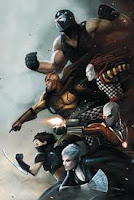
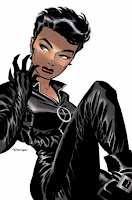 Selina Kyle is a ready-made leading woman. I'd take a heavy influence from Brubaker's run on her book and give it a great gumshoe vibe and a supporting cast including Holly, Karon, Slam Bradley and Leslie Thompkins. The fact that Catwoman is inextricably linked to Batman could cause problems, but she has enough of her own history and stories to carry a good few series' without him: Her training with Wildcat, her background with the Falcone family, her childhood on the streets and rise to wealthy society burglar extraordinaire, with a social conscience. Robin Hood in Louboutins.
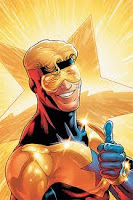 Okay, so a show about Booster Gold won't bring in anyone other than DC's usual white male 18-31 audience. But come on, who wouldn't want to see a comedy action show about the world's tackiest superhero? (I have a soft spot for Booster.)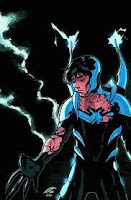
 The Secret Six formed in 2005 in Villains United, a mini-series during Infinite Crisis, and led to a Secret Six limited series in 2006, before finally getting an ongoing in 2008. There have been changes to the team over that time (Knockout, Mad Hatter, Harlequin) but they soon settled on the dream team of Scandal Savage, Catman, Deadshot, Ragdoll, Bane and Jeanette. Like the team themselves, Secret Six was the outsider at DC, out of place alongside black-and-white heroes and villains, but always managing to scrape through and triumph when, by all rights, it should have been cancelled a long time ago. It's hardly family friendly, it repaid the long-term rather than casual reader, and never sold huge numbers. But it was critically acclaimed by anyone who ever picked it up and many comics creators named it as a favourite. It survived beyond its natural shelf-life by sheer talent. It was one of the best books DC was putting out with as passionate a fanbase as any title could ask for.
 But it seems wrong to praise the series for its political agenda, because I don't think it had one. It's not populated with LGBT characters - it's populated with good ones. Deadshot was the only character with any real credibility when the series first started. Catman was a joke and Bane was a fairly one-note villain. Simone made them better than they'd ever been. Ever. Which, admittedly, in Catman's case wasn't hard. But who would have guessed that he'd work so well with Deadshot, or that by the time of the Cats in the Cradle arc he'd be an utterly believable bad-ass, someone who, had it not been for defining events in childhood, could have actually been the hero he always wanted to be. His dying line in the brilliantly bonkers Western one-shot was just so perfect, coming as it did directly after the conclusion to Cats in the Cradle.


